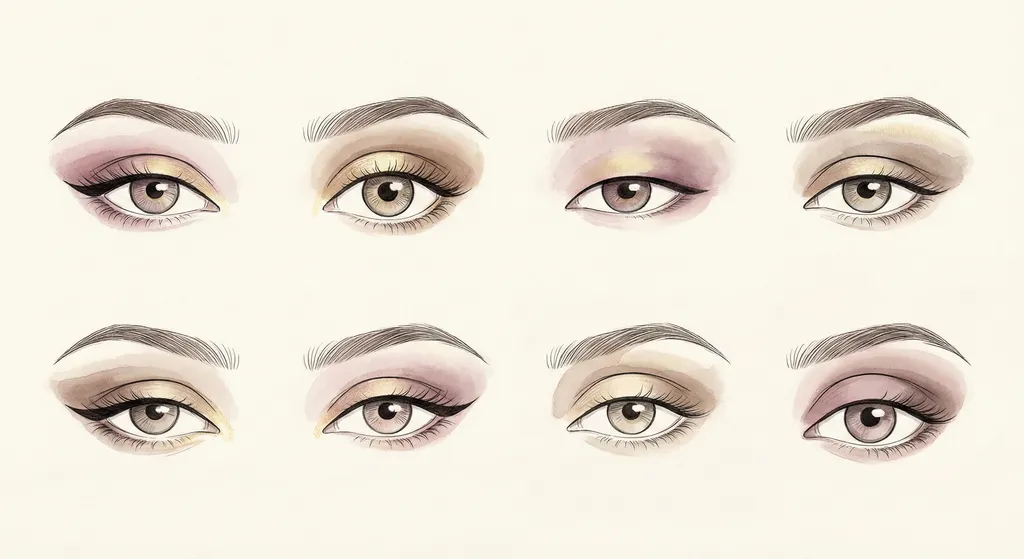
Figuring out your eye shape is the first step toward makeup that works with your features instead of against them. Three main methods exist: the mirror self-assessment, online quizzes, and AI photo analysis. Each has different strengths in accuracy, objectivity, and convenience. This guide compares all three so you can pick the approach that gives you the most reliable answer and the most useful results.
Detect your eye shape with BeautySpark's AIWhy Your Eye Shape Matters for Makeup
Eye shape determines where eyeshadow should be placed, how eyeliner angles should be drawn, and which blending techniques flatter your natural structure. A smoky eye on hooded lids requires different placement than the same look on round eyes. Winged liner on downturned eyes needs a different angle than on almond eyes.
Getting this wrong is the most common reason why a tutorial "doesn't work on me." The technique itself is rarely the problem. The placement is. Knowing your eye shape lets you adjust any tutorial to your specific anatomy, which is why identification matters before you pick up a brush.
For a full breakdown of each shape and its best techniques, see our eye shape makeup guide.
Your eye shape is the single most important factor in choosing eyeshadow placement, eyeliner angles, and blending direction.
The 8 Eye Shapes (Quick Reference)
| Eye Shape | Key Characteristics | Often Confused With |
|---|---|---|
| Almond | Visible iris-to-lid ratio, slightly pointed outer corners, balanced proportions | Oval, upturned |
| Hooded | Visible crease that is partially or fully hidden by a fold of skin on the outer third | Deep-set, monolid |
| Monolid | No visible crease at all; smooth lid surface from lash line to brow bone | Hooded |
| Round | Visible white above or below the iris, lid appears curved and open | Prominent |
| Upturned | Outer corners tilt upward relative to inner corners | Almond |
| Downturned | Outer corners tilt downward relative to inner corners | Round |
| Deep-Set | Eyes sit further back in the skull; brow bone is prominent across the entire lid | Hooded |
| Prominent | Eyes project forward from the eye socket; lids have more visible surface area | Round |
Most people have features of more than one shape. Pure textbook shapes are less common than combinations, which is why identification can be tricky.
Understanding these eight shapes is the foundation, but most real eyes fall somewhere between categories.
Method 1: The Mirror Self-Assessment
How It Works (Step-by-Step)
- Stand in front of a well-lit mirror with your face relaxed. Natural daylight works best.
- Look straight ahead with your eyes open. Do not raise your brows or squint.
- Check your crease: can you see a visible fold above your lash line? If no fold is visible, you likely have a monolid. If the fold disappears when your eyes are open, you may be hooded.
- Check the corners: do your outer corners tilt up, down, or sit roughly level with your inner corners?
- Check the whites: can you see white above or below your iris? Visible white on the sides suggests round or prominent eyes.
Where the Mirror Method Falls Short
Self-perception bias is the biggest issue. People tend to see what they expect rather than what is actually there. It is surprisingly difficult to objectively assess your own crease depth, because you are looking at yourself while trying to keep your face neutral, and even small changes in brow position alter the visible crease.
Asymmetry is another blind spot. Most people have slightly different eye shapes on each side, but the mirror method treats both eyes as identical. Lighting plays a role too: overhead bathroom light creates shadows that can make eyes look more hooded or deep-set than they really are.
Verdict
The mirror method is free, immediate, and requires nothing except a mirror. For people with clearly defined eye shapes (obvious monolids, very round eyes, strong upturn), it works well enough. For subtler shapes or combinations, accuracy drops.
The mirror method is a solid quick check for obvious eye shapes but struggles with subtle differences, hooded-vs-deep-set distinctions, and combination shapes.
Method 2: Online Eye Shape Quizzes
How They Work
Online quizzes walk you through a series of multiple-choice questions: "Can you see your crease with your eyes open?" "Do your outer corners tilt up or down?" "Is white visible below your iris?" Based on your answers, the quiz assigns you one of four to eight eye shape categories.
Why Most Quizzes Oversimplify
The core problem with quizzes is that they rely on the same subjective self-observation as the mirror method, just in a more structured format. You are still the one deciding whether your crease is "visible" or "partially hidden," and that judgment is where most mistakes happen.
Binary questions also miss combination shapes entirely. If your eyes are hooded on the outer third but almond-shaped in the center, no yes/no question captures that. Most quizzes only classify four to six shapes, which lumps distinct shapes together. Deep-set and hooded eyes frequently end up in the same category because the quiz does not ask precise enough questions to separate them.
Verdict
Quizzes add structure to the process, which helps people who feel lost staring in the mirror. But accuracy is not meaningfully better than the mirror method because the data source is the same: your own subjective impression.
Online quizzes give more structure than the mirror alone, but they depend on the same self-reported observations and miss combination shapes.
Method 3: AI Eye Shape Detection
How AI Analyzes Your Eyes
AI eye shape detection works through facial landmark mapping. You upload a photo (or use your phone camera in real time), and the algorithm maps specific points around your eyes to measure their geometry.
Modern AI uses systems like Google's MediaPipe, which tracks 478 three-dimensional face landmarks, with dedicated point clusters around each eye. Older systems like dlib's 68-point model are less precise but still used in some apps. A more recent approach using RT-DETR detects 9 key eye landmarks with 0.974 accuracy.
From these landmarks, AI calculates eyelid contour shape, crease depth and visibility, inner and outer corner angles, iris-to-white ratios, and brow bone prominence relative to the eye socket. The measurement is mathematical: the algorithm compares your proportions against trained models of known eye shapes to produce a classification.
What AI Catches That You Might Miss
Asymmetry detection is where AI has the clearest advantage. The algorithm measures each eye independently, so it can identify that your left eye is slightly more hooded than your right. Most people never notice this about themselves, but it affects how eyeliner and eyeshadow should be applied on each side.
AI also measures subtle lid characteristics that are difficult to judge visually. The ratio between your visible lid space and your crease fold, the exact angle of your outer corners, and the depth of your eye socket relative to your brow bone are all things humans estimate poorly but algorithms measure precisely.
Limitations of AI Detection
Photo quality is the biggest variable. Poor lighting, extreme angles, visible makeup (especially heavy eyeliner or false lashes), and glasses all interfere with landmark detection. Camera distortion from close-up selfies can slightly alter the perceived proportions of your eyes.
Quality also varies widely between apps. Some use basic models with only a few landmark points and produce oversimplified results. Others use advanced multi-point detection that provides detailed analysis. Not all AI eye shape tools are equivalent, so the app you choose matters. For a comparison of AI makeup apps, see our AI makeup app comparison.
Verdict
AI detection is the most objective of the three methods because it measures rather than asks. For most people, it provides the most accurate result, especially for combination shapes and subtle distinctions like hooded vs. deep-set. Quality depends on the app and the photo, so using good lighting and a clean face matters.
AI eye shape detection offers the most objective measurement of the three methods, handles combination shapes well, and catches asymmetry that other methods miss entirely.
Which of the 8 eye shapes are you? One selfie tells you
BeautySpark reads your eye shape and shows the placement that flatters it.


Side-by-Side Comparison
| Criterion | Mirror Method | Online Quiz | AI Detection |
|---|---|---|---|
| Cost | Free | Free | Free to $20 |
| Time | 2 to 5 minutes | 5 to 10 minutes | Under 1 minute |
| Objectivity | Low (self-perception bias) | Low (self-reported answers) | High (measurement-based) |
| Handles asymmetry | Rarely noticed | Not addressed | Yes (each eye measured independently) |
| Detects lid characteristics | Limited | Limited | Detailed (crease depth, lid ratio, corner angles) |
| Number of shapes identified | Depends on reference used | 4 to 8 | 8+ (including combinations) |
| Common errors | Confuses hooded with deep-set | Oversimplifies combination shapes | Photo quality can affect results |
| Best for | Quick check, obvious shapes | Guided exploration | Accurate identification, combination shapes |
AI detection leads on accuracy and objectivity, while the mirror method wins on accessibility and speed for straightforward shapes.
Common Eye Shape Misidentifications (And How to Avoid Them)
Hooded vs. Deep-Set
This is the most frequent mix-up. Both create the appearance of less visible lid space, but the cause is different. Deep-set eyes sit further back in the skull, with the brow bone projecting forward across the entire lid. Hooded eyes have a fold of skin that droops over the crease, typically most visible on the outer third of the lid.
The practical test: if you can see your crease when looking straight ahead but the outer portion disappears under a skin fold, your eyes are hooded. If the brow bone itself creates a shadow across the entire lid and the crease is recessed rather than hidden, your eyes are deep-set.
Almond vs. Oval
These two shapes look very similar. Almond eyes have slightly pointed outer corners and a balanced iris-to-lid ratio where the iris is partially covered by both the upper and lower lids. Oval eyes are softer, rounder versions of almond with less taper at the outer corners.
For makeup purposes, the distinction rarely matters because the same techniques work for both. Where it matters most is eyeliner shape: almond eyes support sharper wings, while oval eyes typically look better with softer, rounded liner.
Monolid vs. Hooded
Monolids have no visible crease at all. The skin from lash line to brow bone is smooth without any fold. Roughly 50% of East Asian individuals have monolids, though they occur across all ethnicities. Hooded eyes have a crease, but it is partially or fully covered by a fold of skin.
The makeup implications are different: monolid techniques focus on creating visible lid definition through gradient shading, while hooded-eye techniques focus on placing color above the fold so it remains visible when eyes are open.
Why Combination Shapes Confuse Everyone
Many people have features from two shapes: almond eyes with a slight hood, round eyes that are also slightly deep-set, or upturned eyes with prominent lids. Forced-choice methods (quizzes, simple mirror guides) struggle with this because they require you to pick one label. AI handles combinations better because it measures individual features independently instead of forcing everything into one category.
Most misidentifications come from confusing hooded with deep-set or monolid, and from trying to force combination shapes into a single label.
Which Method Should You Use?
The right choice depends on what you need:
- Quick check while getting ready? Mirror method. Five minutes, no tools needed.
- Want guidance but no photo? An online quiz provides more structure than the mirror alone.
- Need accurate identification for makeup technique? AI analyzer. Measurement-based results handle subtle shapes and combinations.
- Suspect you have a combination eye shape? AI analyzer. It measures proportions independently and does not force a single label.
- Getting inconsistent results? Try AI with a clean face in natural daylight. If even AI gives you borderline results, you likely have a combination shape, and knowing that is itself useful.
For ideas on how to use your eye shape result in practice, see eyeliner techniques for your eye shape and eyeshadow colors for your eyes.
For most people, AI detection gives the most reliable result. Use the mirror for quick checks, quizzes for guided exploration, and AI when precision matters.
How BeautySpark Uses Eye Shape Detection for Personalized Looks
BeautySpark detects your eye shape from a selfie using facial landmark mapping, the same technology described above. The app also performs color season analysis from the same photo, so you get both your eye shape and your color season in one step.
The app then uses these results together to generate step-by-step eye makeup tutorials (eyeshadow, eyeliner, mascara) tailored to your specific features. You can also scan your own eyeshadow palettes and receive personalized looks built from shades you already own.
BeautySpark focuses exclusively on eye makeup. A subscription is required to access the full tutorial library and personalized recommendations.
BeautySpark combines eye shape detection with color season analysis to generate eye makeup tutorials matched to your exact features.
Which of the 8 eye shapes are you? One selfie tells you
BeautySpark reads your eye shape and shows the placement that flatters it.