Five main methods can identify your color season: online quizzes, DIY draping at home, AI photo analysis apps, virtual consultations, and in-person professional draping. They range from free to $500+, and accuracy varies just as widely. Some take five minutes, others require a scheduled appointment weeks out. This guide compares all five on cost, accuracy, time, and depth so you can choose the right approach for your budget and confidence level.
BeautySpark identifies your color season from a selfie, then generates personalized eye makeup tutorialsThe 5 Methods at a Glance
Before diving into each method, here is a side-by-side overview.
| Method | Cost | Time | Accuracy | Best For | Limitations |
|---|---|---|---|---|---|
| Online quiz | Free | 5-10 min | Low-moderate | Quick starting point | Relies on self-assessment; usually 4-season only |
| DIY draping | Free-$50 | 30-60 min | Moderate | Hands-on learners on a budget | Requires good lighting, no personal bias |
| AI photo analysis | Free-$20 | Under 5 min | Moderate | Speed and convenience | Affected by lighting, camera quality, makeup |
| Virtual consultation | $25-150 | 15-30 min prep + 1-2 week wait | Moderate-high | Expert guidance without travel | Limited by photo quality |
| In-person professional | $150-500 | 45-90 min session | High | Highest confidence result | Cost, scheduling, limited availability |
Each method has a clear use case. The best choice depends on how much accuracy you need and what you are willing to spend.
Method 1: Online Color Analysis Quizzes
How They Work
Online quizzes ask you to describe your hair color, eye color, skin tone, and undertone. Based on your answers, an algorithm matches you to a seasonal category. Most quizzes use the 4-season system (Spring, Summer, Autumn, Winter), though some attempt the full 12-season color analysis breakdown.
Accuracy: What to Expect
Quiz accuracy depends almost entirely on how well you assess your own coloring. If you already know your undertone, you will get a more useful result. If you are unsure whether your veins look green or blue, the quiz cannot help you decide. The preset answer options also force you into broad categories that miss nuance. A Soft Summer might get sorted into generic "Summer" with no further distinction.
Best Quiz Options
ColorMe, Colorwise, and the Carol Brailey quiz are commonly referenced. None require an account or payment. Treat results as a hypothesis to test, not a diagnosis.
Verdict
Quizzes are a free, zero-commitment starting point. They narrow the field from twelve seasons to two or three possibilities, but they cannot reliably distinguish between adjacent sub-seasons because self-reported data has too many blind spots.
Online quizzes work best as a first filter, not a final answer.
Method 2: DIY Draping at Home
What You Need
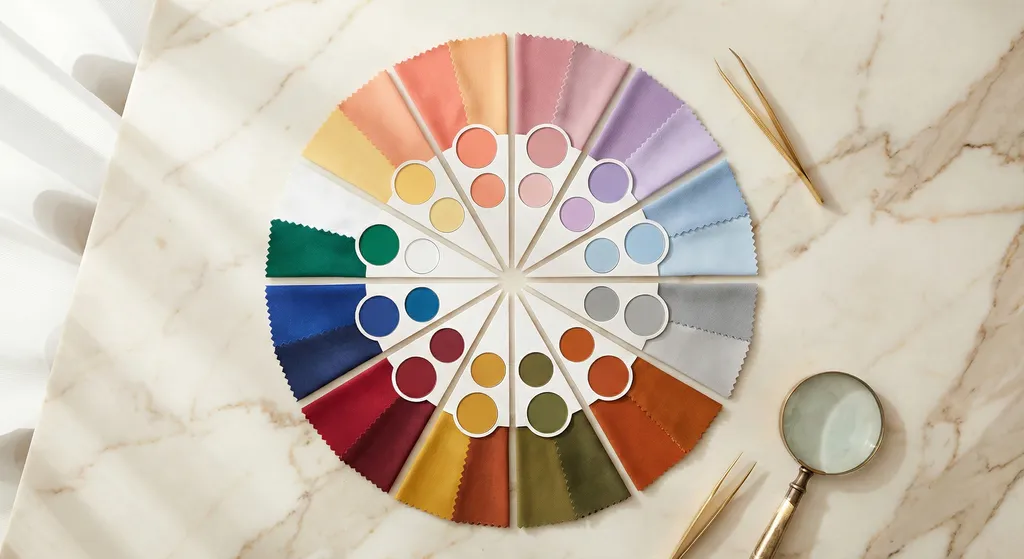
Gather fabrics in a range of seasonal tones: warm gold, cool silver, dusty rose, bright orange, navy, olive, icy pink, burnt sienna. A bathroom mirror near a window works if the light is indirect and neutral. Remove all makeup and pull your hair back so nothing distracts from your skin's reaction to each color.
Step-by-Step Process
Hold each fabric under your chin, one at a time. Watch how your skin responds. Colors in your season make your complexion look even, your eyes brighter, and dark circles less visible. Colors outside your season can make skin look sallow, gray, or ruddy. Compare warm golds against cool silvers first to narrow warm vs. cool, then test muted vs. bright to identify your season family.
Common Mistakes That Skew Results
Personal bias is the biggest risk. If you love wearing black, you might convince yourself it flatters you even when it washes you out. Overhead fluorescent lighting adds a yellow or green cast that distorts skin reactions. A limited color range (only testing five or six swatches) leaves too many gaps. Tanned skin can temporarily shift your apparent warmth, so test during months when your skin is closest to its natural baseline.
Verdict
DIY draping teaches you more about color theory than any other method on this list. The learning itself is valuable. But without training, it is easy to misread subtle skin reactions or let preferences override observation.
DIY draping is the best free method for learning color theory hands-on, but personal bias can steer results off track.
Method 3: AI Photo Analysis Apps
How AI Analyzes Your Coloring
AI color analysis apps use computer vision to extract data from a selfie: skin undertone, contrast level between hair and skin, eye color, and sometimes iris patterns. The algorithm compares those measurements against seasonal profiles and returns a result, often in under a minute.
4-Season vs. 12-Season AI Results
Most free apps classify you into one of four seasons (Spring, Summer, Autumn, Winter). That narrows the field, but it misses the distinction between, say, Bright Winter and True Winter. Some paid apps or premium tiers offer 12-season analysis, which requires more sophisticated models trained on larger datasets.
What Affects AI Accuracy
Lighting is the single biggest variable. A selfie in warm tungsten light shifts your apparent undertone toward yellow. Wearing foundation, blush, or color-correcting primer gives the algorithm your makeup's undertone instead of your own. Camera white balance and screen color calibration also introduce drift. For the most reliable result, photograph your bare face in indirect natural daylight.
Check out AI makeup apps we compared for a deeper look at what different apps offer, and our best seasonal color analysis apps comparison for a pure color-season focus, including a ColorMine AI alternative breakdown.
Discover Your Perfect Eye Look
Get your first AI-personalized look in under 5 minutes.


Verdict
AI apps are the fastest option and the easiest to use. Accuracy has improved significantly with modern computer vision models. The catch is that results are only as good as the input photo: bad lighting or heavy makeup can push the algorithm toward the wrong season.
AI photo analysis is the fastest way to get a color season result, but accuracy depends heavily on lighting and a bare face.
Method 4: Virtual Color Consultation
How Virtual Sessions Work
You submit a set of photos taken in natural light (typically bare-faced, hair pulled back, against a neutral background). A trained analyst studies your coloring digitally, sometimes asking for additional photos in specific lighting conditions. Results arrive in one to two weeks as a detailed report with your season, best colors, and styling notes.
What You Get vs. In-Person
Virtual sessions cost less than in-person draping and eliminate travel. You get professional expertise applied to your coloring, which is a real step up from quizzes or self-assessment. The tradeoff is that the analyst cannot drape fabric against your skin in real time. They are working from photos, and photo quality limits what they can observe. Subtle differences between, for example, True Summer and Soft Summer can be harder to detect through a screen.
Verdict
Virtual consultations offer the best balance of cost and expertise for people who do not have a professional analyst nearby. The results are more reliable than solo methods because a trained eye catches what most people miss about their own coloring.
Virtual consultations give you professional expertise at a fraction of in-person cost, limited mainly by photo quality.
Method 5: In-Person Professional Draping
The Gold Standard: What Happens in a Session
You arrive with a bare face, hair covered or pulled back, wearing a neutral top. The analyst seats you in controlled, color-neutral lighting and drapes precision-dyed fabric swatches across your chest, one at a time. They read your skin's reaction in real time: looking for the shade that makes your complexion clearest, your eyes brightest, and your facial features most defined. Over the course of 45 to 90 minutes, they narrow your season from the broader four-season family down to your specific sub-season within the 12-season system.
Cost and Availability
Professional draping sessions typically cost $150 to $500, depending on the analyst's experience and location. Major cities have more options; rural areas may require travel. Some analysts offer group sessions at lower per-person rates. The investment buys you the highest-confidence result available, plus a trained professional who can explain exactly why certain colors work and others do not.
Verdict
In-person draping is the most reliable method because the analyst controls every variable: lighting, fabric quality, real-time observation, and years of pattern recognition. If you want a definitive answer and can justify the cost, this is the approach that delivers it.
In-person professional draping is the most accurate method available, with controlled conditions and trained observation that no other approach can replicate.
Which Method Should You Choose?
Your choice comes down to where you are in the process and what you need.
- You want a quick starting point: Take a free online quiz. It narrows the field in five minutes.
- You want accuracy without cost: Try DIY draping at home in natural light. It takes more time but teaches you to read color against skin.
- You want speed and reasonable accuracy: Use an AI photo analysis app with a bare-face selfie in daylight.
- You want expert guidance but cannot travel: Book a virtual consultation. Professional eyes on your photos are worth the $25 to $150.
- You want the highest confidence: Schedule an in-person professional draping session. Nothing else matches real-time observation with precision drapes.
Start with the method that fits your budget and time, then move up if you want more certainty.
The Smart Approach: Combine Methods for Confidence
No single method is perfect, and even professional analysts can disagree on borderline cases. The smartest approach is to layer methods. Start with a quiz or AI app to form a hypothesis. Test that hypothesis with DIY draping. If the results align, you can feel confident. If they conflict, a virtual or in-person consultation can settle the question.
Finding your undertone is a useful first step before any of these methods. Once you know whether you lean warm, cool, or neutral, every other method becomes more accurate. For a full breakdown of the 12-season system and what each season means, see our 12-season color analysis guide.
Combining two or three methods gives you more confidence than relying on any single approach alone.
Once You Know Your Season: What Comes Next
Your color season gives you a framework for every beauty and wardrobe decision going forward. Start with colors that suit you for a practical guide to building outfits around your palette.
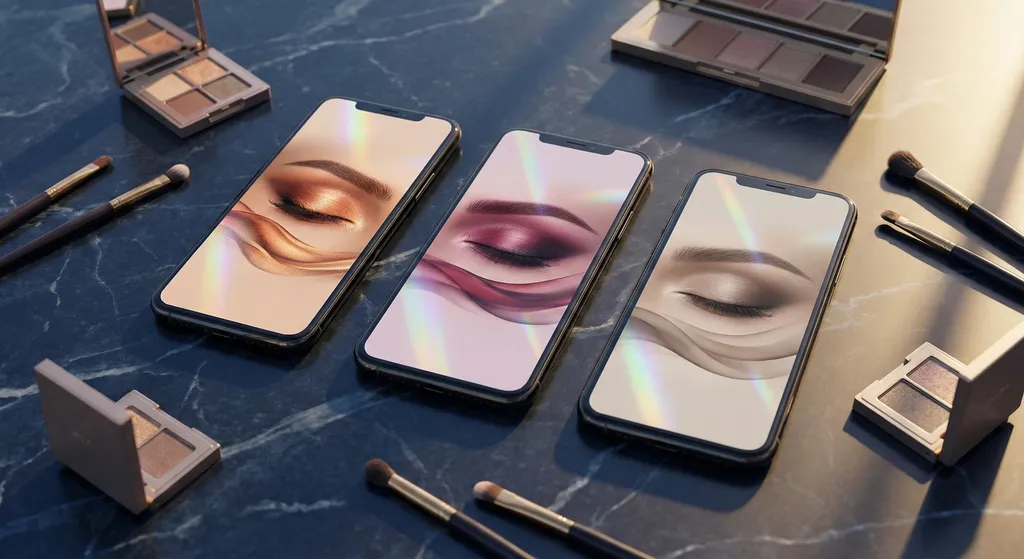
For eye makeup specifically, BeautySpark generates step-by-step eye tutorials tailored to your color season, eye shape, and the eyeshadow palettes you already own. The app identifies your season from a selfie photo and turns that into AI-powered personalized looks you can follow at home.
Knowing your color season is the starting point. The value is in applying it to your daily choices.
Discover Your Perfect Eye Look
Get your first AI-personalized look in under 5 minutes.