You need six brushes, not twenty. Most brush sets include tools you will never touch, and the ones you actually reach for every day fit in one hand. Six essential makeup brushes handle a full face and a detailed eye look. This guide covers the six that earn their spot, four worth adding later, and the ones you can leave on the shelf.
Get a personalized eye makeup tutorial matched to your color seasonWhy Most Brush Sets Are a Waste of Money
The global makeup brush market is worth roughly $7.4 billion, and a big slice of that comes from 15-piece sets where half the brushes sit in a drawer untouched. Sets exist because bundling sells. A fan brush, a lip brush, and a second powder brush pad out the count and justify a higher price tag, but they would struggle to sell individually because most people never need them.
When Into the Gloss asked seven professional makeup artists to name their single most important brush, every answer pointed to a core workhorse: a blending brush, a shader, or an angled brush. None named a fan brush. The professionals who own 30+ brushes still build their work around a small core of shapes a beginner needs.
Identify the brush shapes you actually need first. Then check whether a set contains most of them at a better per-brush price. If it does, the set is the smarter buy. If the set bulks out the count with shapes you will not use, buy individually. The goal is the shapes, not the number of brushes in the box.
You do not need a drawer full of brushes. You need six good ones that earn their place through daily use.
The 6 Essential Makeup Brushes Every Beginner Needs
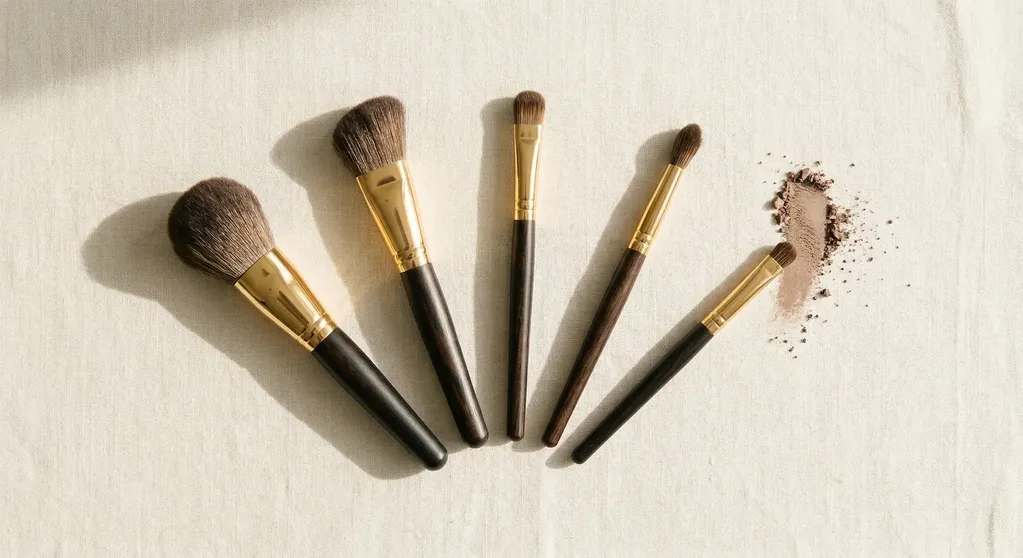
These six cover everything from setting powder to a full eyeshadow look. If you only buy six brushes in your life, make it these.
1. Fluffy powder brush
A large, dome-shaped brush with loosely packed bristles for face powder, bronzer, and setting powder. The soft, rounded shape diffuses product across a wide area so nothing looks streaky or uneven. This is your finishing brush for anything powder-based on the face.
Natural bristles work best here. The tiny cuticle scales on natural fibers grip powder particles and distribute them more evenly than smooth synthetic fibers. Goat hair is the most common and the most affordable natural option.
2. Angled cheek brush
An angled brush follows the line of your cheekbone naturally, making blush and contour placement almost foolproof. The angled cut deposits color along a precise stripe instead of a round circle, which is why it gives you better control than a round brush for sculpting.
This brush works with both powder and cream formulas. Use natural bristles for powder blush, synthetic for cream. If you only want one, synthetic handles both reasonably well.
3. Flat eyeshadow shader brush
This is the difference between "where did my eyeshadow go?" and visible color on the lid. A flat, paddle-shaped, densely packed brush packs pigment onto the mobile lid with full payoff. Press the brush flat against your lid and pat color on in short, firm strokes.
Without a shader brush, you end up sweeping eyeshadow back and forth and losing half the pigment to fallout. The flat surface deposits color where you place it and keeps it there.
4. Tapered crease brush
A tapered brush concentrates color in the crease and then diffuses it outward as the bristles fan. This creates the gradient effect that separates a polished eye look from a muddy one. The pointed tip lets you place shadow precisely in the socket line; the body blends it out as you move the brush back and forth.
Starting out, the tapered crease and fluffy blending brushes alone are enough for a clean eye. Add the small blending brush later, once your looks get more layered.
For more on building layered looks step by step, see our guide to using your eyeshadow palette.
5. Fluffy eyeshadow blending brush
A small to medium dome-shaped brush with soft, loosely packed bristles for all-over eye blending. This is the brush that does the diffusion work on the eye: applying and blending your transition shade across the socket, softening the edges of any shadow you have placed, and unifying the whole eye look so there are no hard lines.
Natural bristles work best for diffusing powder eyeshadow evenly.
6. Angled liner brush
A small, flat, angled brush for gel or cream eyeliner application and brow product placement. The stiff, short bristles give you the control you need for a thin, defined line, and the angled cut follows the natural shape of the lash line and brow. This brush covers two daily jobs (liner and brows) with one tool, which is why it earns a permanent slot.
Synthetic bristles only. Gel and cream formulas need synthetic fibers that do not absorb product.
Six brushes cover a full face and a detailed eye look. Everything else is optional.
4 Brushes Worth Adding When You're Ready
Once the starter six feel second nature, these four extend your range for more detailed work.
Small blending brush
The first upgrade to reach for once the starter six feel comfortable. It handles the detail work a crease brush is too large for: outer V deepening, lower lash line shadow, transition shade refinement. Softer and smaller than the crease brush, with a looser, rounder tip, it lets you blend small areas without disturbing the shadow you already placed.
For techniques adapted to specific eye shapes, this is the brush that does the detail work.
Pencil brush
A tight, pointed brush for smudging eyeliner, placing shadow precisely along the lower lash line, and doing detail work in the inner corner. If you do smoky eye looks regularly or define your lower lash line, a pencil brush makes the work dramatically easier.
Kabuki brush
A dense, flat-top or domed brush, long- or short-handled, for buffing liquid or cream foundation into the skin. The density compresses foundation evenly across the face without streaking. A shorter handle gives you more control for buffing motions, but either length works. If you wear liquid foundation regularly, this is the most efficient way to apply it.
Synthetic bristles only. Natural fibers absorb liquid product and waste it.
Concealer brush
A small, flat, tapered synthetic brush for placing concealer under the eyes, on blemishes, and around the nose. Fingers work but waste product and cannot reach corners. A dedicated concealer brush gives you precision and full coverage with less product.
These four earn a spot once your technique outgrows the starter six.
Discover Your Perfect Eye Look
Get your first AI-personalized look in under 5 minutes.


Brushes You Can Safely Skip
Not every brush that exists needs to be in your collection. These three come in most sets and rarely justify their slot.
Fan brush. Designed for light highlight and blush dusting, but your fluffy powder brush already does this. A fan brush deposits so little product that you end up building layers to get visible color, which defeats the purpose of a dedicated tool.
Lip brush. Lipstick applies directly from the bullet. If you need precision for a dark or bold lip, a small liner brush or even a clean pencil brush works. A separate lip brush is one more thing to wash.
Dedicated highlight brush. A tapered crease brush or small blending brush already handles targeted highlighter placement. A separate highlight brush overlaps with tools you own.
If a brush duplicates what another brush in your kit already does, skip it.
Natural vs Synthetic Bristles: Which Do You Need?
This comes down to what you are applying.
Natural fibers (goat, squirrel, sable) have tiny cuticle scales along each hair. Those scales grip powder particles and distribute them evenly, which is why natural brushes give better results with powders, especially loose powders and finely milled eyeshadows.
Synthetic fibers (taklon, nylon) are smooth and non-porous. They do not absorb product, so they transfer liquids and creams directly to the skin without soaking anything up. This makes synthetic brushes the better choice for liquid foundation, cream blush, concealer, and gel eyeliner.
The quick decision: powder products go with natural bristles, cream and liquid products go with synthetic. If you want to keep things simple, synthetic handles both adequately, just with slightly less payoff on powders.
Synthetic brushes are also easier to clean, more affordable on average, and cruelty-free. For more on how formula type affects application, see our guide to cream vs powder formulas.
Match the bristle type to the formula: natural for powders, synthetic for creams and liquids.
How to Tell if a Brush Is Good Quality
Price alone tells you very little. A $40 brush with a loose ferrule is worse than a $12 brush that passes these three checks. Most brushes are sold in sealed packaging, so you will not be able to test them in store unless a tester is on display. Read reviews before buying, and run these checks at home as soon as the brush arrives, while it is still returnable and before you use it on product.
The shed test. Tug gently on the bristles. A new brush may lose one or two hairs, but more than five means the glue adhesion is poor. Tap the handle against your palm a few times and count what falls out. If bristles keep coming, put the brush back.
The ferrule check. The ferrule is the metal band connecting the bristles to the handle. Twist it. It should not move at all. Look for a clean, flush edge where the ferrule meets the handle, with no visible glue residue or gaps. A wobbly ferrule means the brush will shed and eventually come apart.
The density squeeze. Pinch the bristles at their base. A well-made brush feels dense and springs back to its original shape immediately when you let go. Cheap brushes feel hollow in the center or stay splayed out. Bristles that do not bounce back will not blend well.
If a brush fails any of these three checks on arrival, return it. A shedding or wobbly brush will only get worse with use.
Quick-Reference Table
| Brush | What It Does | Keep or Skip | Natural vs Synthetic |
|---|---|---|---|
| Fluffy Powder | Powder, bronzer, setting | Keep (essential) | Natural |
| Angled Cheek | Blush, contour | Keep (essential) | Either |
| Flat Shader | Packs eyeshadow on lid | Keep (essential) | Either |
| Tapered Crease | Blends shadow in crease | Keep (essential) | Natural |
| Fluffy Eyeshadow Blending | All-over eye blending | Keep (essential) | Natural |
| Angled Liner | Gel liner, brows | Keep (essential) | Synthetic |
| Small Blending | Detail eye blending | Keep (upgrade) | Natural |
| Pencil Brush | Smudging, detail lash line | Keep (upgrade) | Synthetic |
| Kabuki | Buffing liquid/cream foundation | Keep (upgrade) | Synthetic |
| Concealer | Concealer placement | Keep (upgrade) | Synthetic |
| Fan Brush | Light highlight dusting | Skip | N/A |
| Lip Brush | Lipstick precision | Skip | N/A |
| Highlight Brush | Dedicated highlighter | Skip | N/A |
Six earn a permanent slot, four are worth the upgrade, three can stay on the shelf.
Frequently Asked Questions
Discover Your Perfect Eye Look
Get your first AI-personalized look in under 5 minutes.